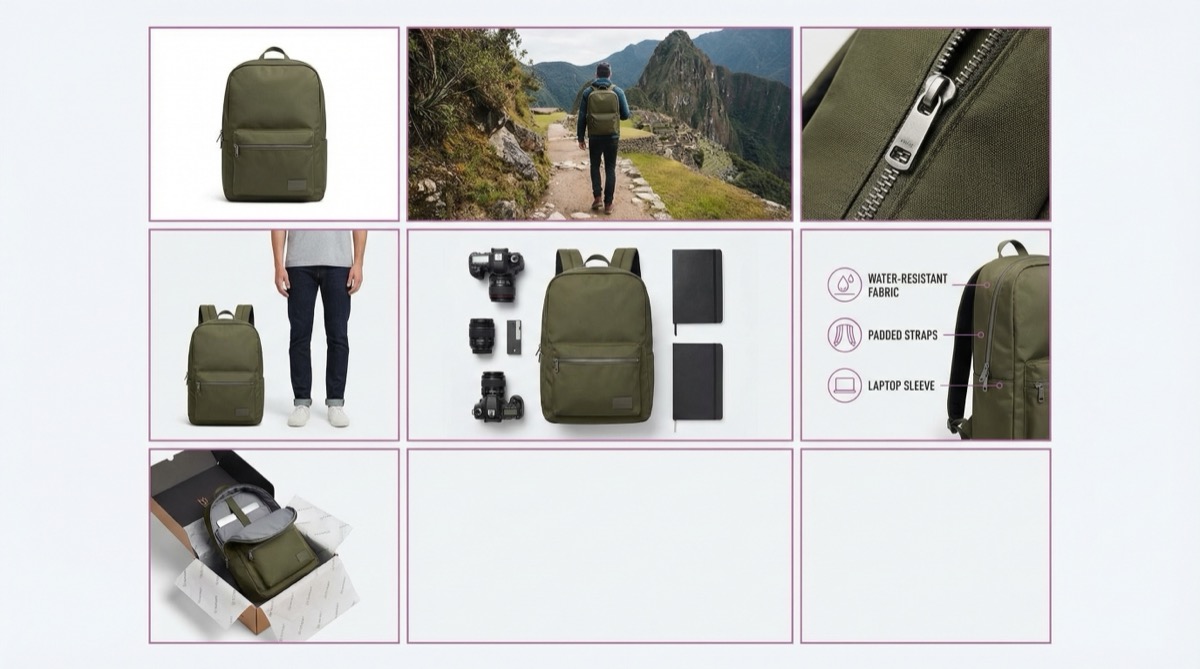
Your product images are the most important factor in whether someone clicks "Add to Cart" or keeps scrolling. On Amazon alone, 83% of buyers say product images are the primary factor in their purchase decision (source: Jungle Scout 2025 Consumer Report).
But here's what most sellers get wrong: they think "product photos" means one nice picture on a white background. In reality, top-performing listings use 7 distinct image types, each designed to answer a specific buyer question and move them closer to purchasing.
Let's break down each one.
The Hero Shot (Main Image)
Purpose: Get the click from search results.
This is the image buyers see in search results. On Amazon, it must be on a pure white background (RGB 255,255,255). But "white background" doesn't mean boring. The best hero shots use:
- Perfect lighting with natural shadows
- A slight 3/4 angle to show depth and dimension
- Product filling 85% of the frame
- High resolution (minimum 2000x2000px for zoom)
Pro tip: Your hero shot competes against 20+ other products on the search results page. The difference between a phone snapshot and a professional studio shot is the difference between page 1 and invisible.
The Lifestyle Shot
Purpose: Help buyers imagine the product in their life.
Show your product being used in a real-world setting. A coffee mug on a desk next to a laptop. A lamp in a cozy living room. Shoes being worn on a city street.
Lifestyle images answer the subconscious question: "Will this look good in MY life?" They create an emotional connection that studio shots can't.
- Match your target audience's aesthetic
- Use warm, inviting lighting
- Show the product as the hero, not lost in the scene
- Include context clues (a kitchen for kitchenware, an office for desk accessories)
The Infographic
Purpose: Communicate key features and specs at a glance.
Not everyone reads bullet points. Infographics combine your product image with text callouts highlighting dimensions, materials, key features, and unique selling points.
- Keep it clean - max 4-5 callout points
- Use icons and arrows, not walls of text
- Highlight what makes you DIFFERENT from competitors
- Include dimensions if size matters (furniture, electronics, clothing)
This image type is the #1 conversion driver according to multiple A/B tests by PickFu and SplitTesting.com. Buyers who see an infographic are 22% more likely to purchase.
The Comparison Shot
Purpose: Show why YOUR product beats the competition.
A side-by-side comparison showing your product vs. "typical" alternatives. This addresses the buyer's inner question: "Why this one and not the cheaper option?"
- "Ours vs. Theirs" format (never name competitors directly)
- Highlight material quality, design details, or included accessories
- Use checkmarks and X marks for quick visual scanning
- Focus on 3-4 key differentiators, not 20 minor ones
The Detail / Close-Up Shot
Purpose: Prove quality through texture and craftsmanship.
Zoom into the details that matter: stitching on leather goods, wood grain on furniture, the weave of fabric, the finish on electronics. This is where you prove that your product is worth the price.
- Use macro-style close-ups
- Show texture, finish, and material quality
- Highlight unique design elements
- If your product has a premium feel, this image sells it
The Scale / Size Reference Shot
Purpose: Eliminate the #1 reason for returns - wrong size expectations.
Show your product next to familiar objects (a hand, a person, a standard object) so buyers know exactly what they're getting. Amazon's #1 return reason is "item was not as expected" - and size is the biggest part of that.
- Include a human hand or person for scale
- Add dimension overlays (length x width x height)
- For furniture: show it in a room with familiar objects
- For small items: place next to a coin, pen, or phone
The Social Proof / Trust Shot
Purpose: Build confidence and reduce purchase anxiety.
This image shows awards, certifications, review highlights, or "As seen in" badges. It answers: "Can I trust this brand?"
- Customer review quotes overlaid on the product
- Certification badges (BPA-free, organic, CE, etc.)
- "100,000+ sold" or "4.8★ rated" social proof
- Warranty or guarantee information
Why Most Sellers Only Use 2-3 Image Types
The math is simple. A professional photographer charges $200-500 per product. Creating 7 different image types for each product means:
- Studio shots: $200-500
- Lifestyle staging: $300-800
- Infographic design: $100-200
- Total per product: $600-1,500
If you have 50 products, you're looking at $30,000-75,000 just for product images. For most small sellers, that's not realistic. So they compromise. They take a few phone photos, slap on a white background, and hope for the best.
The result? Their listings look amateur next to competitors who invested in proper imagery. And on marketplaces where buyers make split-second decisions, amateur images mean lost sales.
The AI Solution: All 7 Image Types From One Photo
This is exactly the problem we built SellPic to solve. Instead of hiring a photographer, renting a studio, and paying a designer - you upload one product photo, and AI generates all 7 image types automatically.
- ✅ Studio hero shot with perfect lighting
- ✅ Lifestyle scenes in realistic room settings
- ✅ Infographic with feature callouts
- ✅ Comparison layout
- ✅ Detail close-ups
- ✅ Scale reference images
- ✅ Social proof templates
Cost: $2.70 per product listing instead of $600-1,500. Generated in under 60 seconds instead of days or weeks.
Create Your Complete Listing in 60 Seconds
Upload one product photo. Get 7 marketplace-ready images. No photographer needed.
Try SellPic Free →Quick Checklist: Are Your Listings Complete?
Before you move on, audit your current listings:
- ☐ Hero shot on white background (professional quality)
- ☐ At least 2 lifestyle images
- ☐ Infographic with key features
- ☐ Comparison or "why us" image
- ☐ Close-up / detail shot
- ☐ Size reference image
- ☐ Social proof / trust image
If you're missing more than 2 of these, you're leaving money on the table. Listings with all 7 image slots filled consistently outperform those with 3-4 images by 25-40% in conversion rate.
"The number one thing I tell new Amazon sellers: fill all 7 image slots with purpose-built images. Not 7 variations of the same angle. 7 different types that each answer a different buyer question." - Kevin King, AM/PM Podcast
What's Next?
Now that you know which image types you need, read our Complete Guide to AI Product Photography in 2026 to learn how to create them quickly and affordably.