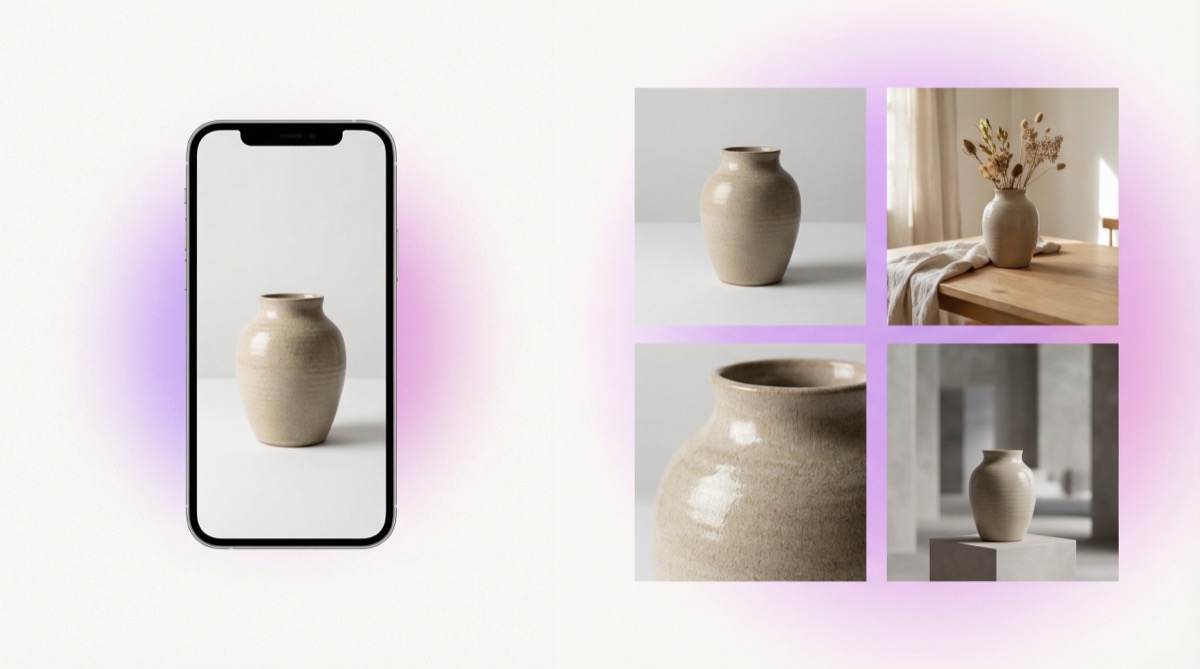
Three years ago, AI product photography was a novelty. The images looked obviously fake. Today, AI-generated product images are indistinguishable from professional studio shots for most product categories. The technology has quietly crossed a threshold that changes the economics of e-commerce forever.
This guide covers everything: how it works, what tools exist, where AI excels (and where it still struggles), what it costs, and how to implement it for your business.
1. How AI Product Photography Works
At the highest level, AI product photography tools do three things:
- Understand your product. The AI analyzes your photo to identify the product, separate it from the background, understand its shape, material, and category.
- Generate new contexts. Using diffusion models (similar to Midjourney or DALL-E, but fine-tuned for products), the AI creates new backgrounds, scenes, and compositions while keeping your product pixel-perfect.
- Output marketplace-ready images. The results are formatted to meet specific marketplace requirements - correct dimensions, white backgrounds where needed, lifestyle contexts where helpful.
The key breakthrough in 2025-2026 has been product identity preservation. Earlier AI tools would subtly change your product - wrong colors, missing details, altered proportions. Modern tools like Photoroom's ID architecture and SellPic's generation engine maintain pixel-level accuracy of the original product while completely transforming the environment around it.
2. The Evolution: 2023 to 2026
2023: The "Obvious AI" Era
Background removal worked well. AI-generated scenes looked fake. Floating products, wrong shadows, inconsistent lighting. Good for social media, not for serious listings.
2024: The Quality Leap
Photoroom's custom diffusion models. Flair's canvas editor. Claid's 4K upscaling. AI images became "good enough" for most marketplaces. But still one-image-at-a-time workflows.
2025: Speed Revolution
Generation speed dropped from minutes to seconds. Photoroom achieved 100x faster generation. Batch processing became standard. AI images became commercially indistinguishable from professional photos.
2026: The Listing Era (Now)
The shift from "edit one image" to "generate complete listing sets." Tools like SellPic generate 7 purpose-built images from a single upload. The focus moves from photo quality (solved) to listing optimization (the new frontier).
3. The Best AI Product Photo Tools in 2026
SellPic
Best for: Complete listing sets (7 images from 1 upload)
Unique feature: Only tool that generates all image types a listing needs: hero shot, lifestyle, infographic, comparison, detail, scale, and social proof.
From $2.70 per product listing
Photoroom
Best for: High-volume background removal and single-image editing
Unique feature: Mobile-first app with 200M+ downloads. Fastest background removal. Enterprise API.
$7.50-35/month
Flair.ai
Best for: Creative control with drag-and-drop canvas
Unique feature: Canvas editor lets you arrange products, props, and backgrounds manually. Virtual fashion models.
Free - $50/month
🔲 Pebblely
Best for: Quick, affordable background swaps
Unique feature: Simplest interface. Pre-made scene themes. Shopify integration.
Free (40 images) - $32/month
Claid.ai
Best for: Enterprise API and 4K output
Unique feature: API-first architecture. 4K upscaling. Custom AI model training.
$19-49/month + custom enterprise
4. Quality: AI vs Professional Photography
The most common question: "Is AI good enough?"
The answer in 2026 is nuanced. Here's a realistic breakdown by category:
AI Wins (indistinguishable or better)
- Home goods & furniture: AI excels at placing products in room settings. Lighting and shadows are natural. 95% of buyers can't tell the difference.
- Electronics & gadgets: Clean surfaces, predictable shapes. AI handles these perfectly.
- Kitchenware & tools: Simple products with clear features. AI generates better consistency than most budget photographers.
- Beauty & skincare: Product packaging is straightforward. AI creates stunning lifestyle contexts.
- Accessories: Bags, wallets, phone cases - AI generates excellent lifestyle and studio shots.
AI Is Good But Not Perfect
- Clothing (on hangers/flat lay): AI handles this well. On models? Getting there but not flawless.
- Food products: Packaging photos are great. Actual food styling is harder for AI (steam, moisture, texture).
Professional Photography Still Wins
- Luxury jewelry & watches: Reflective surfaces, microscopic details. AI can't match a macro photographer here yet.
- High-fashion on models: Complex poses, fabric draping, skin tones. Still a challenge for AI.
- Products with transparent materials: Glass, water, clear plastic. Light refraction is hard to simulate accurately.
"For 85% of the products sold on Amazon, AI product photos are now at or above the quality level of what a $300 product shoot delivers. The remaining 15% are edge cases that will likely be solved within the next year." - E-Commerce Photography Report, 2026
5. The Real Cost Comparison
Let's compare the true cost of getting a full set of 7 listing images:
- Professional photographer: $600-1,500 per product (shooting + editing + styling)
- DIY + Photoroom: $35/month + your time (2-3 hours per product for all 7 types)
- Fiverr/Freelancer: $50-200 per product (quality varies wildly)
- SellPic: $2.70 per product, 60 seconds, all 7 image types
The cost reduction is 99%+ compared to professional photography. But cost isn't the only factor - speed matters too.
A professional shoot takes 1-3 weeks from booking to delivery. SellPic delivers in under a minute. For sellers launching 10-50 new products per month, this speed difference is the real game-changer.
6. Best Use Cases (and Honest Limitations)
Perfect Use Cases for AI Product Photos
- ✅ New product launches - Get listings live immediately, optimize later
- ✅ Low-margin products - Can't justify $500+ per product for photos
- ✅ Seasonal variations - Same product, different colors/sizes, need unique images for each
- ✅ A/B testing - Generate 3 different hero shots, test which converts best
- ✅ Dropshipping - Transform supplier photos into professional listing images
- ✅ International expansion - Same product, need images for different marketplaces
When to Use Real Photography Instead
- ⚠️ Luxury products where perceived quality must be flawless
- ⚠️ Products where texture is the main selling point (fabrics, leather)
- ⚠️ When you need lifestyle shots with real humans interacting with the product
- ⚠️ Brand campaigns where every image needs to be 100% unique and custom
7. Getting Started: Step-by-Step
Here's the fastest path from "no images" to "complete listing" in 2026:
- Take ONE good photo of your product. Use a smartphone with good lighting. Place the product on a flat surface with a neutral background (white paper works). Natural light from a window is ideal.
- Upload to SellPic or your tool of choice. The AI handles background removal, lighting correction, and scene generation.
- Select your marketplace. Amazon, eBay, Etsy, Shopify - each has different requirements. The right tool will optimize for your target platform.
- Review and download. Check that colors are accurate and the product details are preserved. Download all 7 image types.
- Upload to your listing. Fill all available image slots. Each image type goes in a specific slot for maximum conversion.
Total time: 5-10 minutes per product. Compare that to 2-3 weeks with traditional photography.
Ready to Try?
Upload your first product photo and get 7 marketplace-ready images in 60 seconds. Free to start.
Create Your Listing Images →8. What's Next for AI Product Photography
The field is evolving fast. Here's what's coming in the next 12-18 months:
- AI product videos: Static images evolving into 5-second product videos (spin, zoom, lifestyle). Amazon already supports video - AI will make it accessible to every seller.
- Real-time A/B optimization: AI testing different image styles and automatically selecting the highest-converting variant.
- AR/3D integration: AI product photos converting into 3D models for augmented reality "try before you buy" experiences.
- Marketplace auto-upload: Direct API integration - generate images and push them to your listing without manual download/upload.
- Custom brand training: Train AI on your brand's specific aesthetic, so every product matches your visual identity automatically.
The bottom line: AI product photography isn't the future - it's the present. Sellers who adopt it now have a structural cost and speed advantage that will compound over time. Those who wait will find themselves competing against listings with professional-quality images created at a fraction of the cost and time.